
The Death of the Pirate Ship
By Dan Kahn
I’m going to say the quiet part out loud: Your company is not a family.
For decades, “we’re a family” was the ultimate corporate recruiting line. It was meant to signal a deep, unconditional belonging. But in reality, it’s a lie that serves no one. Families don’t fire people for being “poor contributors” or having a bad attitude. Conversely, family members don’t usually walk out on Thanksgiving because the neighbor offered them a 15% bump in their allowance and a better title.
Lately, the pendulum on LinkedIn has swung hard in the other direction. The new mantra is: “Stop saying we’re a family; it’s just a job.” I generally agree with that. But in the era of Zoom, hybrid work, and the rapid-fire integration of AI, we’ve landed in a strange, sterile middle ground. We aren’t a family, but if we just become a “work product producing machine” fueled by a global, disconnected workforce, we lose the very thing that makes a career worth having. We lose the “Pirate Ship.”
The Lessons of the Darkroom
To understand what I mean by the “Pirate Ship,” you have to understand where I started. When I was 19, I landed a job at a small, chaotic publishing company that was essentially a den of industry outlaws. I was young, arrogant, and had zero idea how to actually do the job.
I remember my first major photo shoot. This was the end of the film era, and I was using a borrowed, manual Nikon FE. A week later, the art director called me into his office—a literal dark dungeon of a room. Before I could even say hello, something whizzed past my ear and hit the wall. Then another. It was my slides. He was chucking my work at my head while loudly proclaiming that my photography was garbage.
It was demoralizing. It was humiliating. It was also the most important moment of my early career.
In that “Pirate Ship” environment, there was nowhere to hide. You couldn’t “log off” or “Slack” your way out of a confrontation. The friction was immediate and visceral. It forced me to choose: quit and stay mediocre, or gut it out and master the craft. I stayed. I learned exposure, framing, and balance. That friction forged pig iron into steel.
The problem today is that in our current Zoom-first culture, no one is throwing slides. We’ve traded the heat of the forge for the comfort of the couch.
The Mr. Spacely Trap
When leaders realize they aren’t a “family,” they often swing toward the other archetype: The Mr. Spacely.
If you grew up watching The Jetsons, you know the type. Mr. Spacely was the short-tempered, alpha-male boss who spent his day screaming “JETSON!” and threatening to fire George Jetson every five minutes. It’s the same “Alpha” energy we see in Ron Swanson or even Tony Soprano—leaders who are stoic, detached, and often jerks.
For the first decade of running my own firms, I’ll admit I fell into the Spacely trap. I walled off my emotions. I was a taskmaster, not a coach. I viewed my employees as “light fixtures in a flipper house”—valuable, sure, but ultimately replaceable parts of a machine.
But I’ve learned the hard way that a sterile machine is just as bad as a fake family. When you treat people like cogs, they act like cogs. They put their own needs above the team. They disengage. They wait for a better offer and disappear in the middle of the night.
At Kahn Media, we’ve worked tirelessly to find a third way. We start every meeting with “The First Five”—intentional gratitude where we call out wins and recognize people for going above and beyond in the first five minutes of every call. I do one-on-one calls with every staffer to check on their human side. I have an anonymous suggestion box where I respond to every comment with total transparency on staff calls. We are trying to be a High-Performance Team, not a family and not a factory.
The Gym-Hopper and the Growth Gap
There is a major challenge with this modern, high-empathy model: the lack of resilience.
Over the last few years, the prevailing advice for young professionals is that the only way to “level up” is to jump ship every eighteen months. If you want a title bump or a 20% salary spike, you move on. While that is a great way to grow a bank account, it is a catastrophic way to grow as a human.
Real growth—the kind that builds character, expands your EQ, and sharpens your instincts—comes from pushing through hard things. It comes from staying in the room when a project goes sideways, owning the mistake, and gutting out the solution.
When you skip jobs every year or two, you are effectively “glitch-hopping” through your career. It’s like going to the gym and quitting the moment the weights get heavy. You leave that gym, sign up for a new one across town, and start back at the light weights. You might feel like you’re “moving,” but you aren’t making gains.
Eventually, you run out of gyms. You reach your 30s or 40s with a resume full of impressive titles but the internal “muscle mass” of a junior associate. Meanwhile, the people who stayed, dealt with the “slides” being thrown at them, and saw projects through to the end are now ten times stronger than you. They didn’t just get a title; they got the quiet confidence that comes from surviving the storm.
The 2026 Strategy: Open Books and the “Swiss Army Knife” Lattice
Even when you get the culture right and turnover is low, you hit the “Full House” wall. Everyone wants upward mobility. Everyone wants a promotion every year. But if you promote everyone every two years to keep them from “gym-hopping,” you eventually end up with a team full of “Directors” with no one left to do the actual work.
So how are the world’s best organizations currently solving this? They are moving away from the “Career Ladder” and toward the Career Lattice.
A recent note in our employee suggestion box struck a chord with me. The staffer mentioned that we are a team of “Swiss Army Knives,” and suggested we might want to focus more on becoming a team of specialists. I have mixed feelings about that. On one hand, I’ve built my entire career as a Swiss Army Knife. I went to school for journalism, learned print, saw the digital wave coming, and taught myself HTML. I pivoted to PR, then social media, then experiential marketing and D2C strategies. Most recently, we launched an AI discovery service to help brands be recommended by top LLMs.
Much like the Industrial Revolution a century ago, the current technological shift is happening at a breakneck speed that feels unnatural and uncomfortable. If you don’t have the “multi-tool” ability to adapt, you get left behind. In marketing and communications, being a Swiss Army Knife isn’t just a bonus—it’s a survival requirement.
However, I also see the value of the specialist. In a world where AI can swoop in and handle basic, commoditized tasks, we still need the “Razor Sharp” artist, the deep strategist, and the person who knows a specific market segment better than any algorithm ever could.
The solution we are pursuing in 2026 is a blend of both. We want to encourage people to chase the specialties they find gratifying and fulfilling—adding massive value to the client—while remaining flexible enough to pivot when the market demands it.
To support this, we are moving to a version of Open Book Management and a formal Profit Sharing Program. When the books are open, the “Swiss Army Knives” and the “Specialists” can both see exactly how their work affects the bottom line. It turns employees into stakeholders. If the team wins, everyone sees it in their check. This creates “Productive Friction”—not because the boss is screaming like Mr. Spacely, but because your teammates are counting on you to pull your weight so the “First Five” gratitude moments translate into real, shared financial success.
Finding the Third Way
How do we keep the “Pirate Ship” energy alive in a world of remote work and AI? It requires a fundamental shift in how we lead.
- Rebrand as a High-Performance Team: Stop calling it a family. Start calling it a team. In a team, there is a common goal and a high standard. My job is to be the coach—to give you the tools, the feedback, and the “gym” to grow in. And as a coach, that means both pushing teammates to lift heavier weights and build more muscle, while also acting as a human shield to protect them from the inbound chaos often associated with growth and scale.
- Incentivize Mastery, Not Just Management: Use the Career Lattice to reward people who become world-class at their craft. You don’t need a “Director” title to be the most valuable person in the room.
- Embrace the Burn: A 2026 study from Korn Ferry notes that “reskilling” is now the single greatest retention lever. We have to teach our teams that the “burn” they feel during a hard project is actually the sound of their market value increasing.
- The Transparency Pact: By sharing the financials and the profits, we reduce the “us vs. them” power dynamic. When people understand the why behind the pressure, they are much more likely to lean into it rather than run from it.
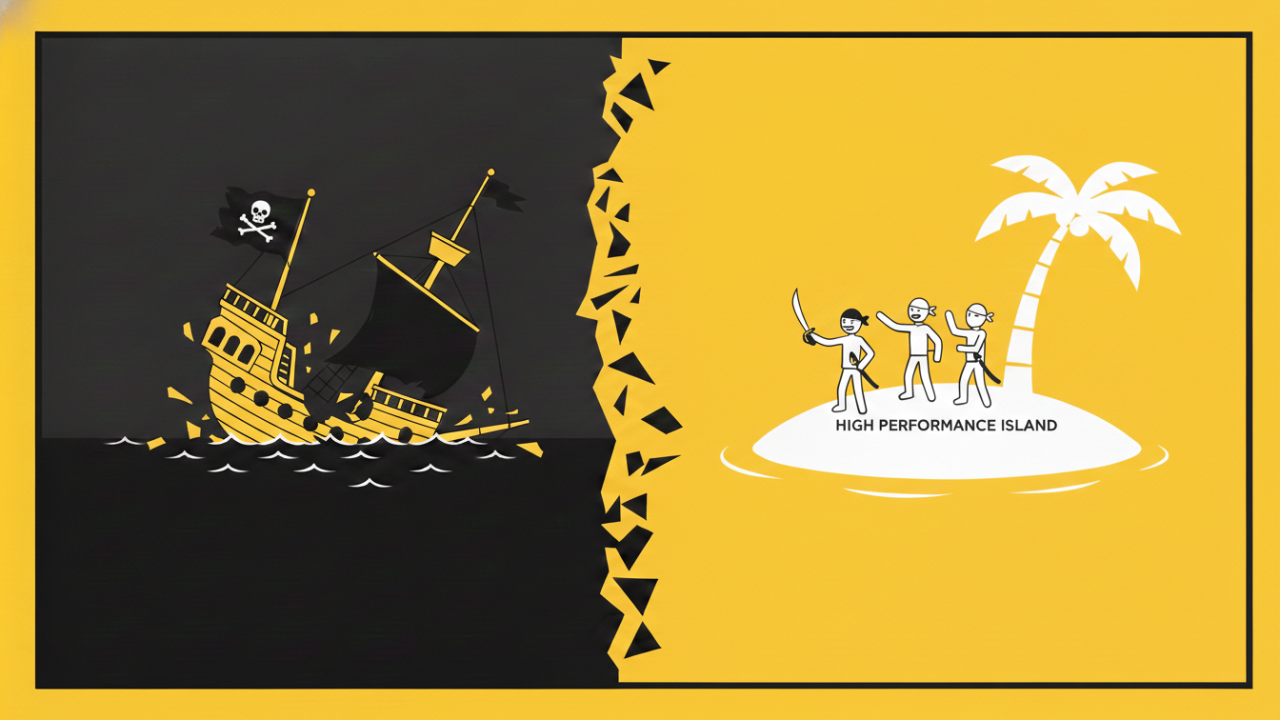
Get off the ship and onto the Island
The “Next Dan” probably won’t have slides thrown at his head in a dark room. The world has changed, and mostly for the better. We have more tools, more flexibility, and more awareness than ever before.
But the fundamental physics of growth haven’t changed. You cannot become a leader if you never stay long enough to deal with the consequences of your own decisions. You cannot build resilience if you leave the moment the work gets “lumpy.”
My goal for the next decade is to build a place where the weights are heavy, the coaching is world-class, and no one feels the need to go look for another gym. We aren’t a family, but we are a group of stakeholders committed to making each other better. And in this AI-driven, remote-first economy, that might be the most valuable thing a leader can offer. Because at the end of the day, a title is just a line on a resume, but the grit you earn by gutting out the hard years? That’s yours forever.